
How Much
Will £100 a Month Grow To? (UK Compound Interest Examples)
If you invested £100 per month consistently,
the results over time can become surprisingly large thanks to the power of
compound interest.
For example:
- £100/month
invested for 10 years at a 7% annual return could grow to around £17,000
- Over
20 years, it could become roughly £52,000
- Over
30 years, it could exceed £120,000
The key reason is compound growth — where your
investment returns begin earning returns themselves over time.
Use our compound interest calculator to test
different contribution amounts, time periods, and interest rates to see how
your savings could grow.
What
Happens If You Invest £100 Per Month?
Many people assume small monthly investments
won’t make much difference. In reality, investing consistently over long
periods can produce substantial growth.
Here’s an example using:
- £100
monthly contribution
- 7%
annual return
- Monthly
compounding
|
Time Period |
Total Contributed |
Estimated Value |
|
10 Years |
£12,000 |
~£17,000 |
|
20 Years |
£24,000 |
~£52,000 |
|
30 Years |
£36,000 |
~£122,000 |
The longer you stay invested, the more
powerful compounding becomes.
Why
Compound Interest Matters
Compound interest means you earn returns on:
- the
money you invest
- the
previous returns you’ve already earned
Over time, this creates exponential growth.
The standard compound interest formula is:

In practical terms, time is usually more
important than trying to find the “perfect” investment.
Example:
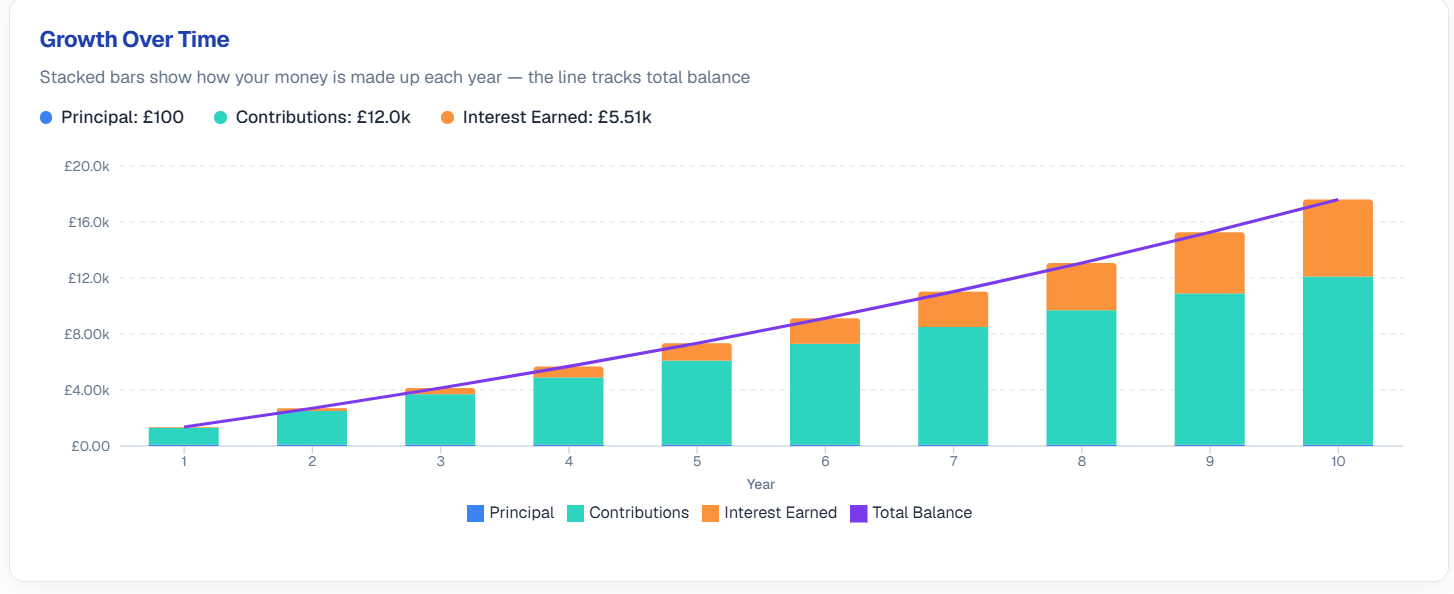
£100 Per Month for 10 Years
If you invest £100 every month for 10 years:
- Total
invested: £12,000
- Estimated
growth at 7%: around £5,000
Final value:
- Approximately
£17,000
At this stage, most of the final value still
comes from your own contributions rather than investment growth.
Example:
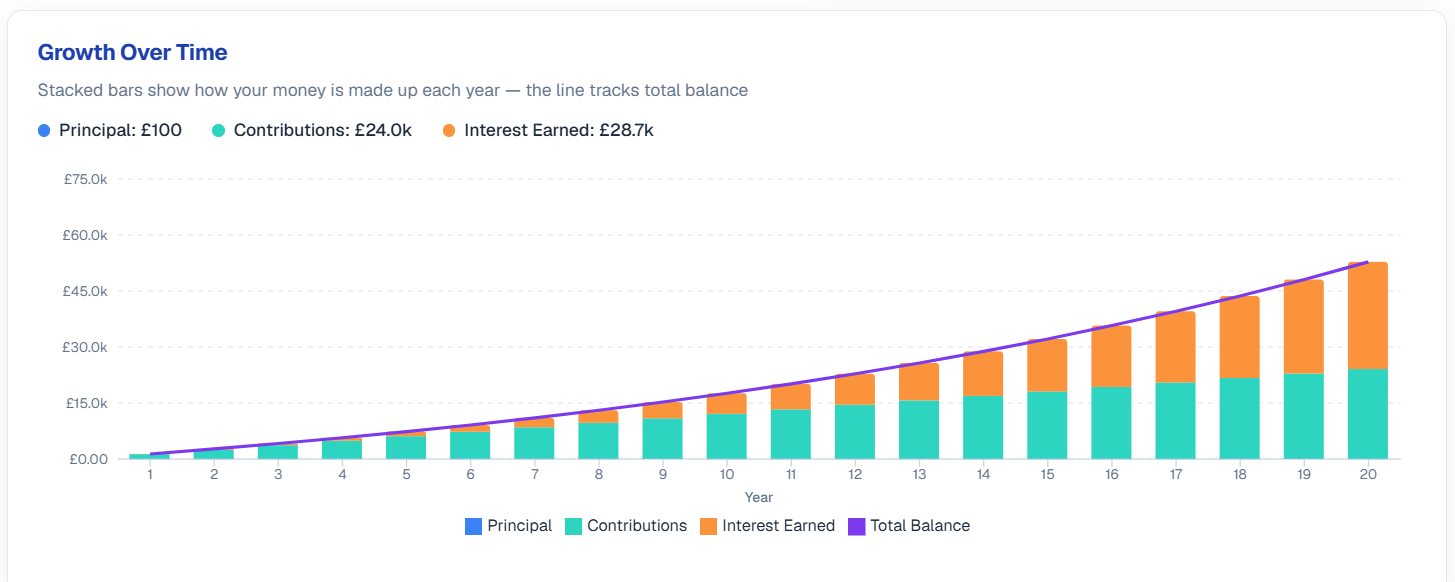
£100 Per Month for 20 Years
After 20 years:
- Total
invested: £24,000
- Estimated
investment growth: roughly £28,000
Final value:
- Around
£52,000
This is where compound growth starts
accelerating noticeably.
Example:
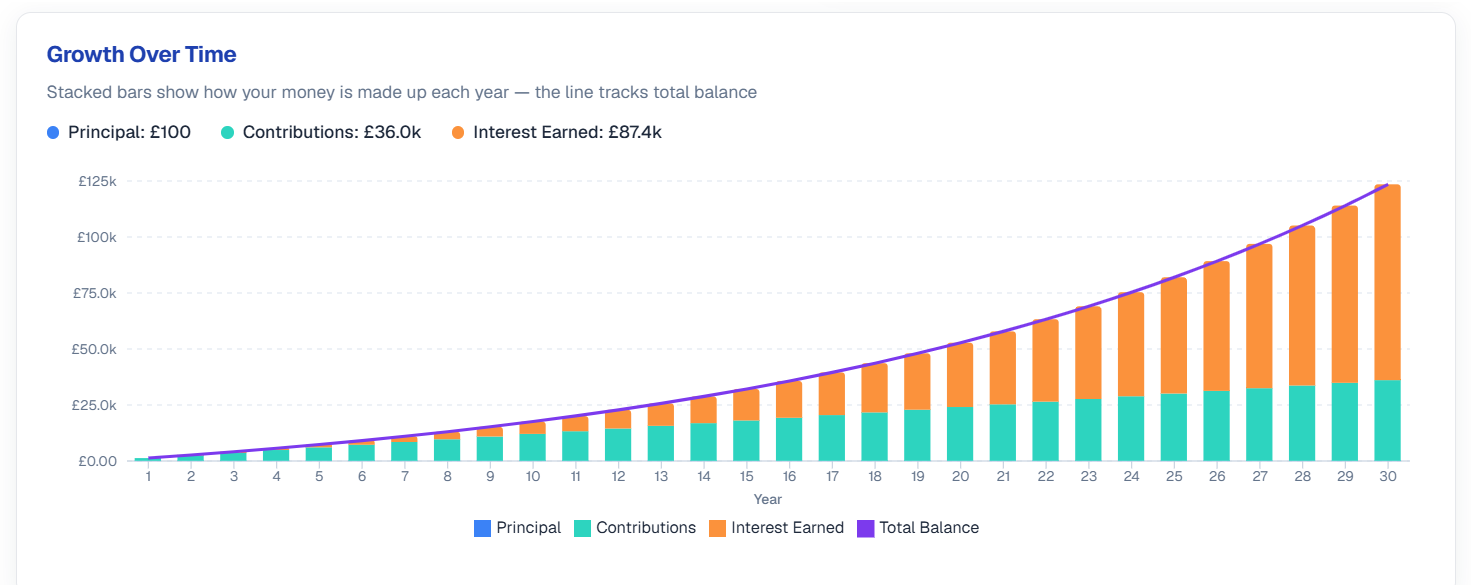
£100 Per Month for 30 Years
After 30 years:
- Total
invested: £36,000
- Estimated
growth: more than £80,000
Final value:
- Around
£120,000+
At this point, the majority of the portfolio
value comes from growth rather than contributions.
What
Return Rate Is Realistic?
No investment return is guaranteed.
However, long-term stock market returns have
historically averaged around:
- 6%–8%
annually after inflation for global equities
- lower
for savings accounts
- higher
risk for more aggressive investments
Many UK investors use:
- Stocks
& Shares ISAs
- index
funds
- pension
investments
- ETFs
to benefit from long-term compound growth.
Does
Inflation Affect Compound Interest?
Yes.
Inflation reduces the real purchasing power of
money over time.
For example:
- £100,000
in 30 years may not buy what £100,000 buys today
That’s why many investors aim for returns that
outperform inflation over the long term.
Is £100
Per Month Enough to Start Investing?
For many people, yes.
The most important factors are usually:
- consistency
- time
- staying
invested
Even relatively small monthly contributions
can grow significantly over decades.
Increasing contributions later can accelerate
growth even further.
Tips to
Maximise Compound Growth
Start Early
The earlier you begin investing, the more time
compounding has to work.
Invest
Consistently
Regular monthly investing helps smooth market
volatility over time.
Reinvest
Returns
Allowing dividends and gains to stay invested
increases long-term growth.
Increase
Contributions Gradually
Even small increases over time can have a
major impact.
Frequently
Asked Questions
How much
will £100 a month grow to in 30 years?
At a 7% annual return, £100 invested monthly
could grow to approximately £120,000 after 30 years.
What is the
best compound interest investment in the UK?
Many UK investors use:
- Stocks
& Shares ISAs
- index
funds
- pensions
- ETFs
for long-term compound growth.
Can I
become wealthy investing £100 a month?
Over very long periods, consistent investing
can build substantial wealth, especially if contributions increase over time.
What
interest rate should I use in a calculator?
Many long-term investors use estimates between
5% and 8% annually for stock market investments. Savings accounts are usually
lower.
Final
Thoughts
Compound interest rewards consistency and
patience.
Even investing £100 per month can potentially
grow into a six-figure portfolio over time if you stay invested long enough.
The earlier you start, the more powerful
compound growth becomes.
Try different scenarios using our compound
interest calculator to see how changing:
- monthly
contributions
- investment
returns
- time
periods
can affect your future savings.